
 Svenska
Cart
Your cart is empty, but doesn't have to be..
Hampus Niskala |25/11, 2026
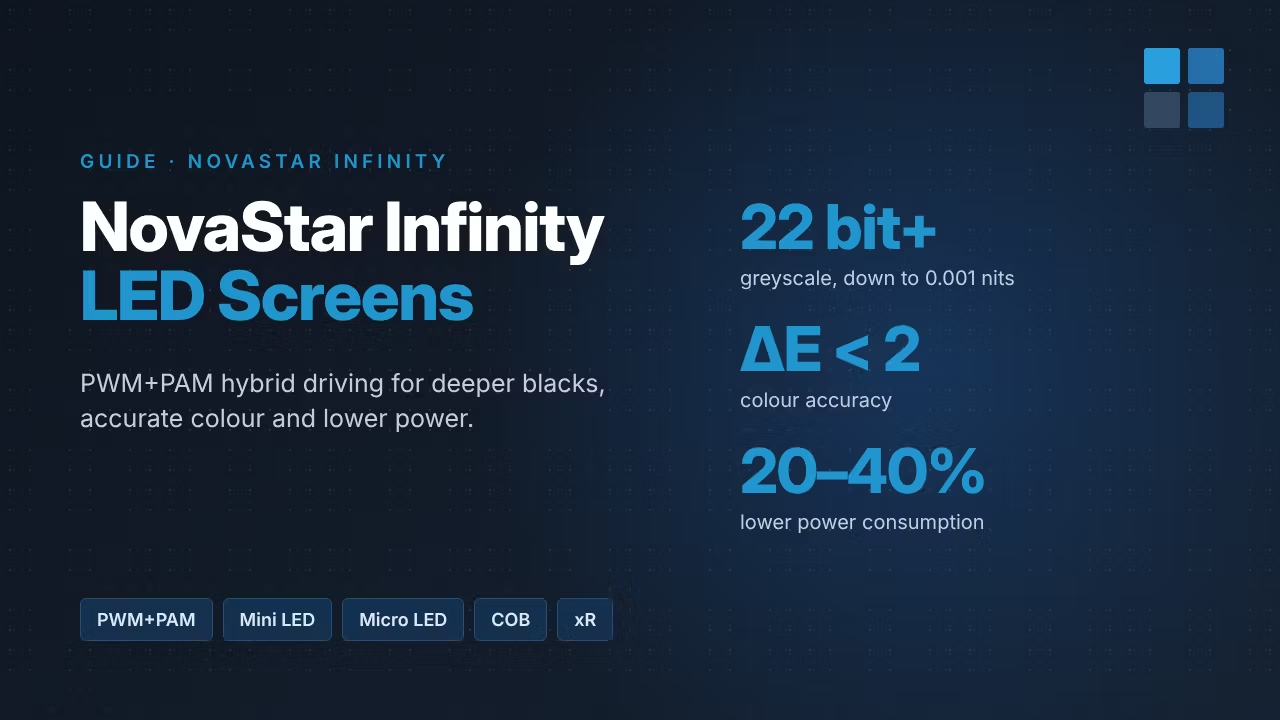
NovaStar Infinity is NovaStar's new driving solution for LED screens. Instead of controlling brightness with pulse width alone (PWM), Infinity adds pixel-level current control (PAM). The result is an LED display with deeper blacks, higher peak brightness, smoother gradients, more accurate colour and lower power consumption. In this guide we explain what NovaStar Infinity is, how PWM+PAM hybrid driving works, what it gives you in practice, and how to get an LED screen built on the Infinity solution through Pixel Pitchers.
Planning an LED screen with NovaStar Infinity? Contact us for a quote →
NovaStar Infinity, officially the Infinity Solution, combines three things:
In NovaStar's own words, the goal is to "set a new visual standard for the LED display industry". It is aimed at screens where image quality really matters: fine-pitch Mini LED and Micro LED walls, COB screens, virtual production and xR stages, broadcast studios, control rooms and premium corporate and retail displays.
Because Infinity works at the driver IC level, it is not a box you add to an existing screen. The LED screen has to be built with Infinity-capable driver ICs and driven by a matching NovaStar control system. That is why the right time to think about Infinity is before you buy the screen.
Almost every LED screen today uses PWM (pulse width modulation). Each LED runs at a fixed current and is switched on and off very quickly; the longer it is on during each cycle, the brighter it looks. This works well, but it has three built-in limits:
PAM (pulse amplitude modulation) controls the current through each LED. Infinity uses PWM and PAM together, giving two-dimensional control over brightness: how long the LED is on, and how much current flows while it is on.
Because PAM takes over part of the work, the PWM pulses can be longer. That frees up time in each refresh cycle, so the screen can refresh more often even at the lowest grey levels.
| Conventional PWM driving | NovaStar Infinity (PWM+PAM) | |
|---|---|---|
| Brightness control | Pulse width only, fixed current | Pulse width and per-pixel current |
| Greyscale | Limited by greyscale clock speed | 22 bit+, 64× more grey levels, control down to 0.001 nits |
| Refresh rate at low grey levels | Often drops, visible scan lines on camera | Refresh at grey level 1 improved by 4 to 8 times |
| Colour accuracy | Colour shifts at low brightness | ΔE < 2, automated colour calibration and verification |
| Contrast | Limited by fixed current | Brighter highlights and deeper blacks, HDR-like effect from SDR sources |
| Power consumption | Fixed current at all levels | 20–40% saving with frame-by-frame dynamic algorithm |
Figures as published by NovaStar for the Infinity Solution. Real results depend on the LED modules, driver ICs and configuration of each screen.
NovaStar quotes 22 bit+ greyscale, a 64× greyscale improvement and brightness control down to 0.001 nits. In practice that means smooth gradients without banding, and clean shadow detail even when the screen is dimmed for a studio, a dark auditorium or a control room. Multi-layer full-greyscale calibration generates calibration coefficients for every grey level, which keeps Mini LED and Micro LED screens uniform at low brightness, exactly where conventional calibration struggles.
For broadcast, virtual production and xR, the refresh rate at low grey levels is what decides whether the camera sees scan lines. Because PAM lets the PWM pulses get wider, Infinity improves the refresh rate at grey level 1 by 4 to 8 times compared with traditional PWM, according to NovaStar. Combined with NovaStar features such as Genlock, that makes Infinity screens a strong choice for camera-facing LED walls.
Infinity supports fully automated colour standardisation, calibration and verification, adapting to the target colour gamut (sRGB, Rec.709, DCI-P3 and Rec.2020) with a colour difference of ΔE < 2. NovaStar's AI-driven adaptive thermal compensation maps image content to screen temperature and corrects colour and brightness as the screen heats up, so a screen that has been on for ten hours still matches the one that was just switched on. NovaStar states colour temperature deviation stays within ±100 K.
By pushing highlights brighter with PAM and keeping shadows clean at minimum pulse width, Infinity widens the dynamic range of the screen. NovaStar says even an SDR source can be shown with an HDR-like effect, with no blown-out highlights and no lost detail in the shadows.
Infinity saves energy in several ways:
Less power means less heat, lower running costs, less cooling and a longer screen lifespan. For a 24/7 control room or an outdoor advertising screen, that adds up quickly.
Infinity is designed as an end-to-end chain, from video processing to sending, receiving and the driver ICs on the modules. On the control side, NovaStar's current platform is COEX, run by the VMP software. COEX controllers such as the MX40 Pro, MX30, CX40 Pro and MX6000 Pro already bring NovaStar image-quality features like 22 bit+, HDR, Dynamic Booster and full-greyscale calibration together with Armor receiving cards such as the A10s Pro.
The exact controller and receiving card combination depends on the LED modules and driver ICs in your screen, so we always confirm it per project. Large Infinity screens are also a natural match for NovaStar 5G, which carries far more pixels per cable than 1G Ethernet; see our NovaStar 5G cable guide and our article on COEX load capacity.
For calibration in the field, NovaStar's NovaCLB (CC3) calibration software is available from us as well.
NovaStar does not make the LED screens themselves. Infinity is built into screens by LED manufacturers who design their modules around NovaStar's Infinity driver ICs and control system. To get an Infinity screen you need three things to fit together: the LED modules and cabinets, the Infinity driver ICs, and the right NovaStar controller, receiving cards and configuration files.
That is where Pixel Pitchers comes in. Pixel Pitchers is run by Microbus Electronic Service AB in Malmö, Sweden, a company with over 40 years of experience and a NovaStar distributor in Europe. We help you:
Contact us for a quote on a NovaStar Infinity LED screen →
Tell us the size, application and timeline of your project and we'll come back with a proposal.
NovaStar Infinity is NovaStar's LED driving solution that combines PWM+PAM hybrid driving in the driver ICs, intelligent image algorithms and NovaStar's display control system. It gives LED screens finer greyscale (22 bit+), better low-brightness performance, ΔE < 2 colour accuracy, higher contrast and 20–40% lower power consumption.
PWM controls brightness by how long an LED is switched on in each cycle, at a fixed current. PAM controls brightness by changing the current itself. Infinity combines both, so each pixel can be controlled in two dimensions.
Normally not. Infinity depends on the driver ICs on the LED modules, so it has to be designed into the screen. A new controller or receiving card alone does not turn a conventional PWM screen into an Infinity screen. If you are planning a new screen, contact us early in the project.
Yes. Higher refresh rates at low grey levels, accurate colour and stable thermal behaviour are exactly what camera-facing LED walls need, and xR and virtual production are among the main applications NovaStar names for Infinity.
Yes. Infinity's multi-layer full-greyscale calibration is designed specifically to keep fine-pitch Mini LED and Micro LED screens uniform at low grey levels.
Pixel Pitchers supplies NovaStar products from stock in Sweden and helps customers across Europe source LED screens built on NovaStar Infinity. Get in touch for a quote.
Official information from NovaStar: NovaStar Infinity Solution and the COEX Wiki Infinity page.
Request a quote for an Infinity LED screen →
NovaStar COEX controllers →
NovaStar receiving cards →
Ready-to-ship COB LED wall kits →