
 Svenska
Cart
Your cart is empty, but doesn't have to be..
Your cart is empty, but doesn't have to be..
Hampus Niskala |27/10, 2026
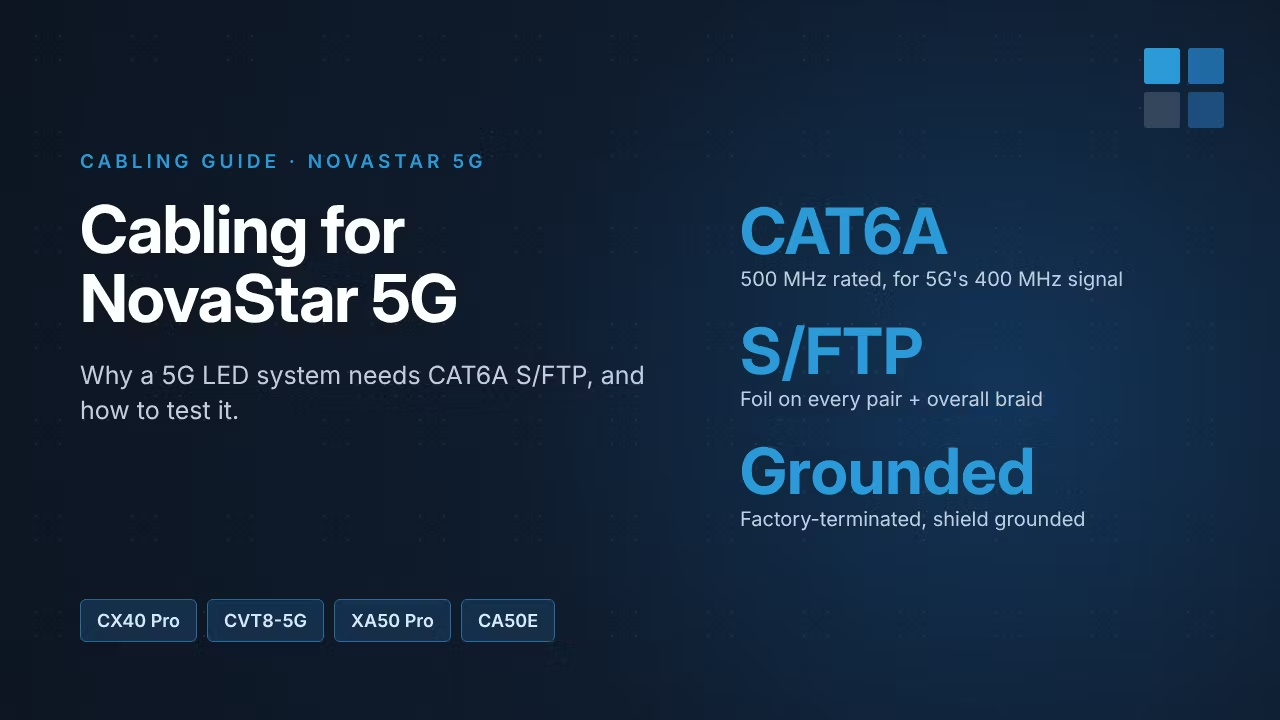
NovaStar's 5G LED control carries about five times the data of a classic Gigabit port over the same RJ45 connector. That's what lets a CX40 Pro drive 9 million pixels from just six outputs. But 5G is far less forgiving about cable quality. A cable that works fine on a 1G system can cause flicker, dropped cabinets or link errors on 5G. This guide explains which cable to use and how to test it.
| 1G BASE-T | 5G BASE-T | |
|---|---|---|
| Standard | IEEE 802.3ab (1999) | IEEE 802.3bz (2016) |
| Signal coding | PAM-5 | PAM-16 |
| Frequency range | 0–125 MHz | 0–400 MHz |
| Required signal-to-noise | about 20 dB | about 32 dB |
| Main interference | Crosstalk inside the cable (NEXT) | Crosstalk from neighbouring cables (alien crosstalk) |
In plain terms: 5G packs 16 signal levels into each symbol instead of 5, so the levels sit much closer together (about 4.7 times closer). It needs a much cleaner signal, and it is most sensitive to noise coming from other cables next to it. That's exactly the situation inside an LED wall, where dozens of data and power cables run side by side.
For 5G LED control, NovaStar requires CAT6A S/FTP cable:
If you have a certification tester such as a Fluke, NovaStar recommends these settings:
A green result is a pass. If a cable fails, re-seat the connectors first. A shield continuity failure usually means the shield isn't terminated properly at one end.
Not sure whether to go 1G or 5G? Read how many pixels a COEX controller can drive, or send us your screen details and we'll advise.
Pixel Pitchers ships NovaStar from Sweden: order in-stock items by 14:00 CET for same-day UPS Express, with delivery in 1–2 days across the EU and no import duties.