
 Svenska
Cart
Your cart is empty, but doesn't have to be..
Your cart is empty, but doesn't have to be..
Hampus Niskala |27/10, 2026
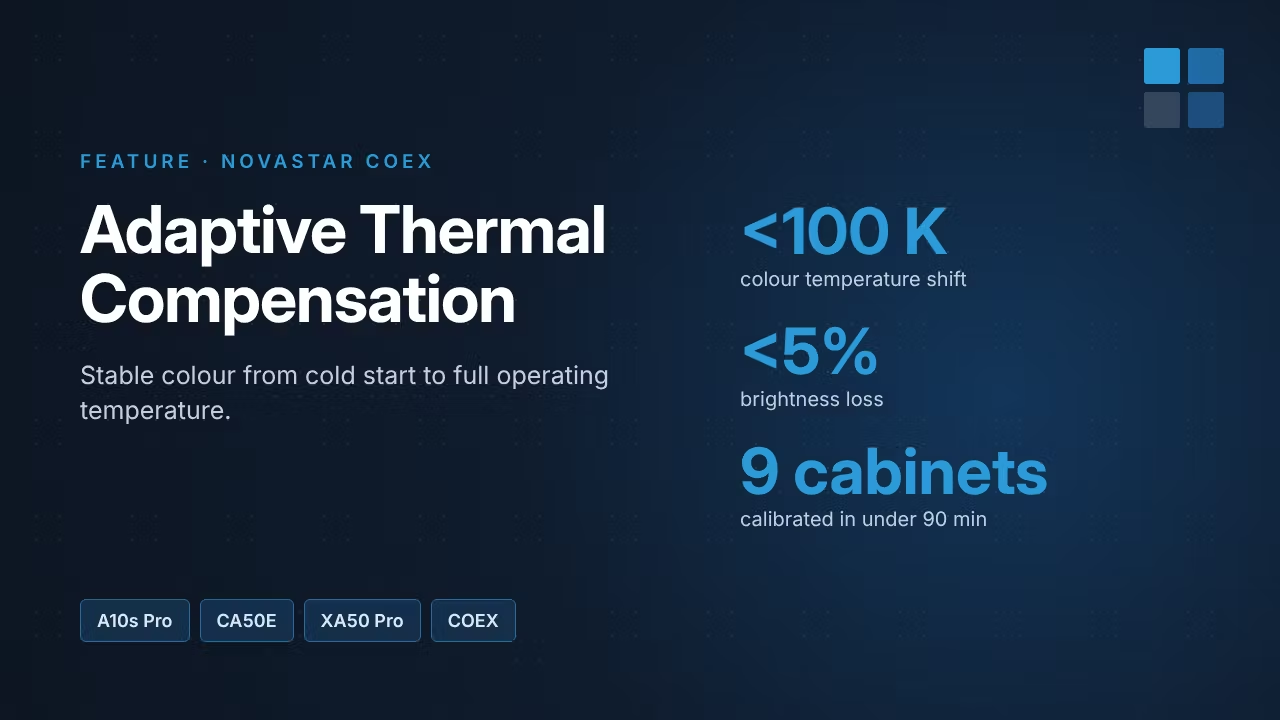
An LED screen that looks perfectly calibrated when you switch it on can look different an hour later. As the cabinets warm up, the LEDs' colour temperature shifts, and because heat is never spread evenly across a wall, some areas drift more than others. NovaStar's Adaptive Thermal Compensation corrects this in real time. Here's how it works and what you need.
LEDs change their output with temperature, and red, green and blue don't change by the same amount. The result is a colour shift as the screen goes from cold to operating temperature. On top of that, cabinets heat unevenly: the top of a wall often runs warmer than the bottom. You end up with visible patches, even on a screen that was calibrated cold.
This is especially noticeable on transparent screens, grille screens and rental screens, which are often switched on just before a show and change temperature fast.
The system applies a correction coefficient that matches the screen's temperature at that moment, keeping colour and brightness close to the calibrated state. There are three ways to set it up:
You don't have to measure every cabinet. A block of 3 × 3 cabinets (9 in total) is calibrated, and the resulting coefficients are loaded into all cabinets from the same production batch. According to NovaStar, this takes under 90 minutes.
| Measure | With Adaptive Thermal Compensation |
|---|---|
| Colour temperature shift (cold to hot) | under 100 K |
| Colour coordinate shift | under 0.01 |
| Brightness loss | under 5% |
The end user can turn the feature on or off, and the correction runs automatically during operation.
If your screen runs for long periods, is used for camera work, or has a design that heats unevenly, Adaptive Thermal Compensation is worth asking your LED manufacturer about. The control system side is simple: a COEX controller and supported receiving cards, both of which we stock.
Pixel Pitchers ships NovaStar from Sweden: order in-stock items by 14:00 CET for same-day UPS Express, with delivery in 1–2 days across the EU and no import duties.