
 Svenska
Cart
Your cart is empty, but doesn't have to be..
Your cart is empty, but doesn't have to be..
Hampus Niskala |20/10, 2026
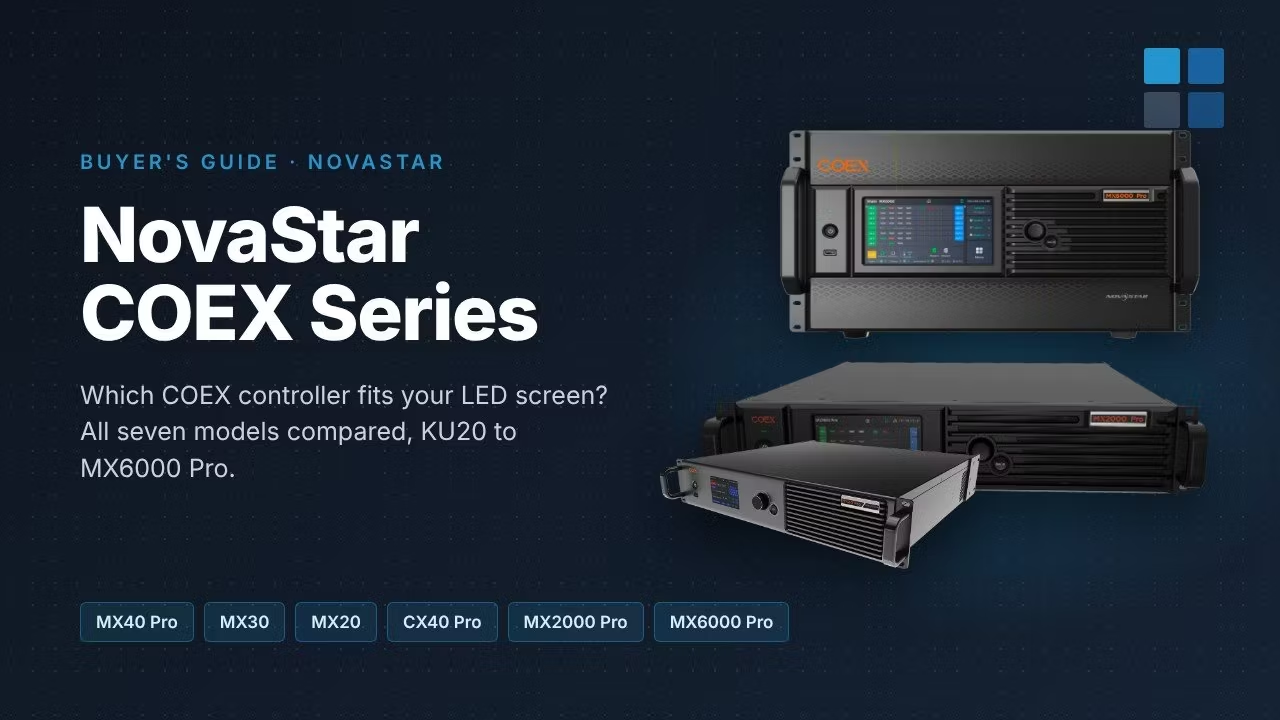
NovaStar's COEX series covers everything from a single-HDMI controller for a small fixed screen to a modular 8K system for stadium-size LED walls. This guide compares all seven current NovaStar COEX controllers, so you can pick the right one for your next project. Updated October 2026.
| Model | Inputs | Outputs | Max load | Layers | Best for |
|---|---|---|---|---|---|
| KU20 | 1x HDMI 1.3 | 6x 1G Ethernet, 1x 10G fiber | 3.9 million pixels | 1 | Small fixed installations, one source |
| MX20 | 2x HDMI 1.3, 1x 3G-SDI | 6x 1G Ethernet, 2x 10G fiber | 3.9 million pixels | 3 | Small events, churches, Genlock on a budget |
| MX30 | 1x HDMI 2.0, 1x HDMI 1.4, 1x DP 1.1, 2x 3G-SDI | 10x 1G Ethernet, 2x 10G fiber | 6.5 million pixels | 3 | Mid-size rental and fixed screens with a 4K source |
| MX40 Pro | 3x HDMI 2.0, 1x DP 1.2, 1x 12G-SDI | 20x 1G Ethernet, 4x 10G fiber | 9 million pixels | 4 | 4K rental, broadcast and xR, 1G receiving cards |
| CX40 Pro | 2x HDMI 2.0, 1x DP 1.2, 2x 12G-SDI | 6x 5G Ethernet, 1x 40G fiber | 9 million pixels | 3 | 4K screens on 5G receiving cards, fewer cables |
| MX2000 Pro | 2 input card slots (up to 8x 4K@60Hz or 4x 8K@30Hz) | 2 fiber output card slots | 35.38 million pixels | 4 per output card | 8K and large events in a 2U chassis |
| MX6000 Pro | 8 input card slots (up to 32x 4K@60Hz or 8x 8K@60Hz) | 8 fiber output card slots | 141 million pixels | Up to 32 4K layers | Stadiums, xR/VP studios, the biggest shows |
Load capacity at 8-bit, 60Hz. Specifications from NovaStar's V1.5.0 documentation.
The NovaStar KU20 is the simplest way into COEX: one HDMI input, up to 3.9 million pixels, and the same VMP software as the bigger models. It suits fixed screens with a single source, where you don't need layers or Genlock.
The NovaStar MX20 has the same 3.9 million pixel capacity, but adds a second HDMI input, 3G-SDI, three layers and Genlock for camera work. It's a good fit for small events, houses of worship and smaller rental screens.
The NovaStar MX30 steps up to 6.5 million pixels over 10 Ethernet ports and takes a 4K@60Hz source over HDMI 2.0, with HDR10 and HLG. For many mid-size rental and fixed installations, it's the sweet spot in the range.
The NovaStar MX40 Pro is the 4K flagship of the fixed-I/O models. It drives 9 million pixels over 20 Gigabit Ethernet ports, takes three HDMI 2.0, DP 1.2 and 12G-SDI sources, and adds the features camera and broadcast work needs: four layers, 12-bit, 3D LUT, frame multiplication, Shutter Fit and sync phase offset. If you're building with 1G receiving cards such as the A10s Pro, this is the one to look at.
The NovaStar CX40 Pro has the same 9 million pixel capacity but uses six 5G Ethernet outputs instead of twenty 1G ports. Each 5G port carries about four times the load of a classic port, so you run far fewer cables. It needs NovaStar's 5G receiving cards, and has a 40G fiber port for long runs.
For 8K content and the largest screens, COEX moves to plug-in input and output cards. You choose the inputs your project needs (HDMI 2.0 and 2.1, DP 1.2 and 1.4, 12G-SDI or SMPTE ST 2110 over IP), and outputs run over fiber to NovaStar fiber converters. See all COEX input and output cards.
The NovaStar MX2000 Pro fits two input and two output cards in a 2U chassis, for up to 35.38 million pixels. It's the practical choice for large rental events, TV studios and e-sports. If you want everything in one order, the MX2000 Pro Complete Kit comes ready to go.
The NovaStar MX6000 Pro is the top of the COEX range: a 6U chassis with eight input and eight output card slots, up to 141 million pixels, dual power supplies and full redundancy. It's built for stadiums, xR and virtual production stages, and the biggest live shows.
The NovaStar CX80 Pro has been discontinued. For 8K projects, the MX2000 Pro is the closest current replacement.
Pixel Pitchers ships NovaStar COEX controllers from Sweden. Order in-stock items by 14:00 CET for same-day UPS Express, with delivery in 1–2 days across the EU and no import duties.
Not sure which model you need? Send us your screen size, pixel pitch and receiving cards, and we'll help you choose.
Browse all NovaStar COEX controllers →